Teaching for Understanding with AI: a Roadmap

A common opinion among educators is that AI is going to make students think less by offering quick and “efficient” ways to complete homework, cheat on summatives and exams, thus bypassing thinking entirely. After all, AI was not created with education in mind.
My experience with AI has been quite the opposite. As a school administrator, I had to deal with the multiple complexities of AI as well as develop the agility to handle the volatility of these tools. If anything, it made me think more about thinking, think deeper about the impact of academic technology on learning, and think differently as well.
So my stance today is simple. What if AI offers us an opportunity to deepen thinking? What if we already had the tools we needed to interact meaningfully with AI? What if we could use these tools as a roadmap to guide our students learning with AI?
From early on, I have been convinced that the ideas from Project Zero, an innovative research center from the Harvard Graduate School of Education, rooted in inquiry-based learning and character education, were well-suited to help us navigate the rise of AI in education. But could they hold up in the age of artificial intelligence, when billions of dollars get invested in tools that, in return, get (supposedly) “smarter and smarter”?
One of the frameworks that seems promising to use in this novel context is Project Zero’s Map of Understanding developed by Ron Ritchhart’s Cultures of Thinking project. This model identifies eight “thinking moves” that foster deep learning and understanding—skills like reasoning with evidence, making connections, or capturing the heart of a concept, idea, text or whatever complex resource we want students to engage with. When multiple thinking moves are activated, learners demonstrate a deep understanding of what is at stake.
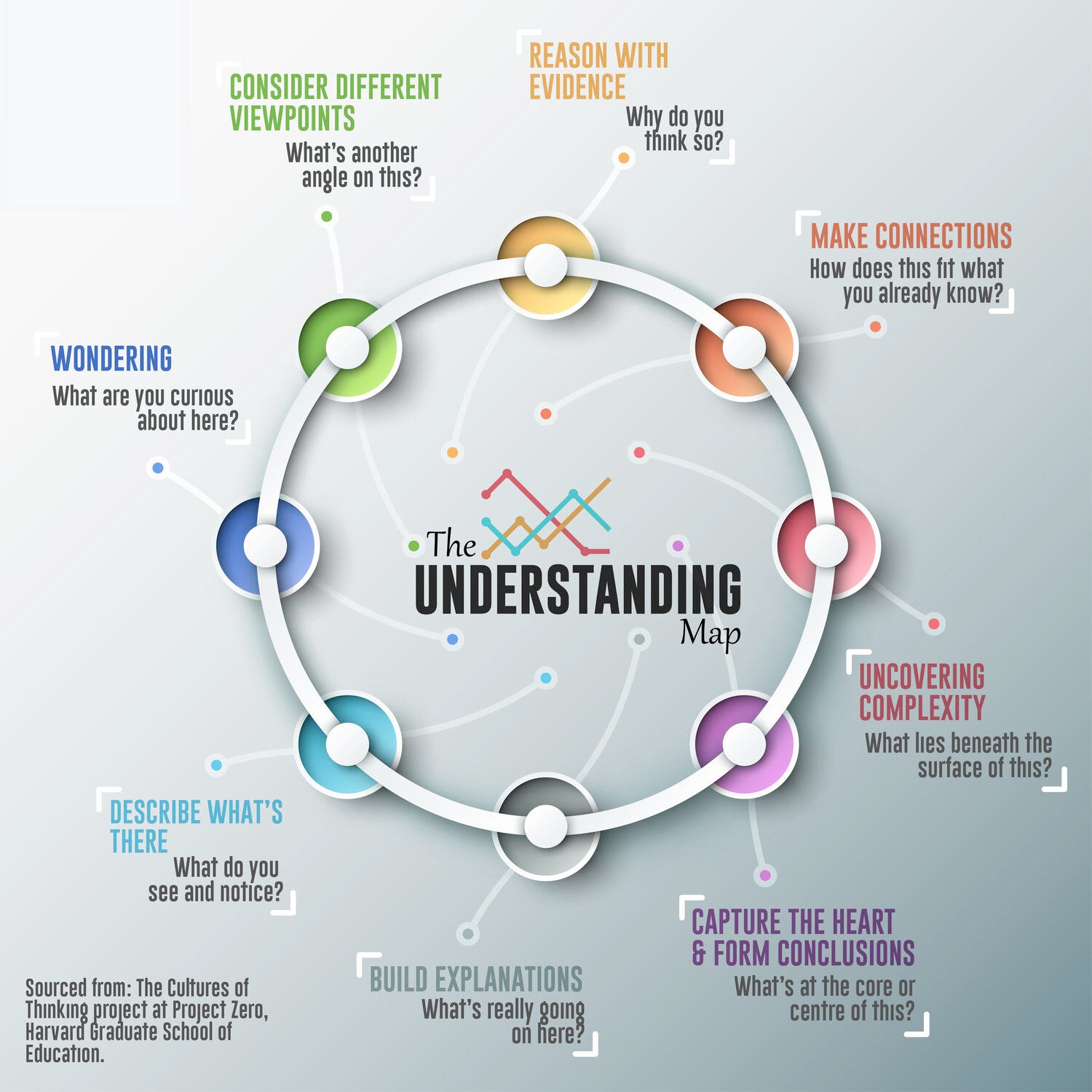
What if the Map of Understanding could be a tool for students to evaluate the output of an AI tool? I entered a simple prompt in ChatGPT to see if certain thinking moves would appear in the answer:
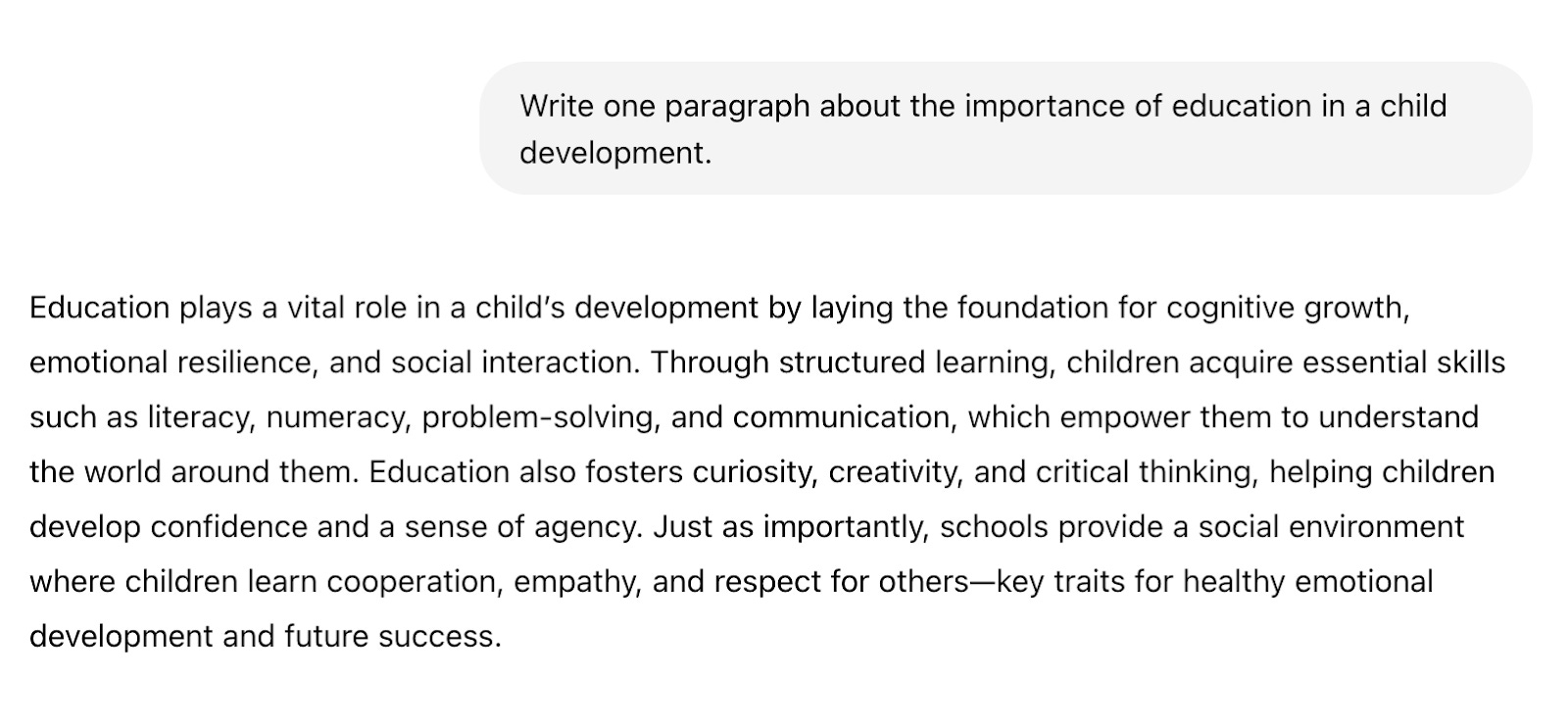
I noticed that it was pretty good at describing what’s there (taking in consideration my request for conciseness), reasoning with evidence (some bots, such as Gemini or Perplexity, cite their sources, for example), or building explanations: the former literature teacher in me noticed the use of connecting devices and a first sentence that looks like a mini thesis. It also provided several lists of three or four items that are easy to remember.
Then I got particularly interested in the following move: wondering. Does AI wonder? Could this know-it-all be curious?
AI became curious only if prompted. AI was designed to seek answers, not questions. As Ron Ritchhart says in his book “Cultures of Thinking in Action”, “we can’t directly teach dispositions; we must enculturate them.” If you need to prompt someone (or in this case, a machine) to be curious about something, it is not curiosity.
Here is what happened when I poked further:
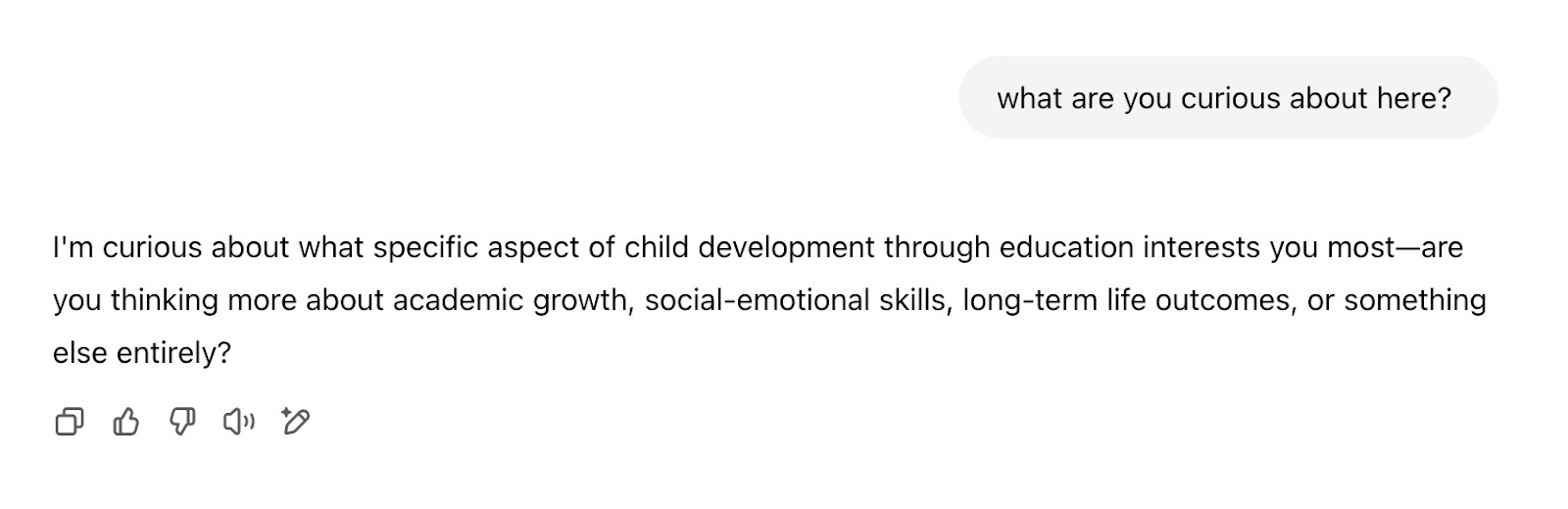
If prompted, it was not “curious” about the topic but about the user. AI was not created to be curious about something; it was designed to be curious about someone, acting almost like a mirror. I wonder what it could mean for students.
We could do the same thing for all thinking moves. It’s already well understood that AI is not well suited for considering different perspectives (that’s where bias comes in) or capturing the essence of a topic, idea, or text (which is different from summarizing it).
Judging what AI can and cannot do using the understanding map is not necessarily the point here. The Understanding Map is uncovering what AI’s current strengths and limitations might be, and how evaluating an AI output draws us into reflection about what good thinking is, making students agents of their own learning.
At the same time, reflecting solely on the output of AI does not seem enough, and I feel the need to discuss the process of using AI, the user/machine interaction, and how we can shape the type of conversation it creates. While the Map of Understanding offers a snapshot of cognitive moves, it does not include the journey of thinking and understanding. Another Project Zero routine called “Peel the Fruit” from the Visible Thinking project does.
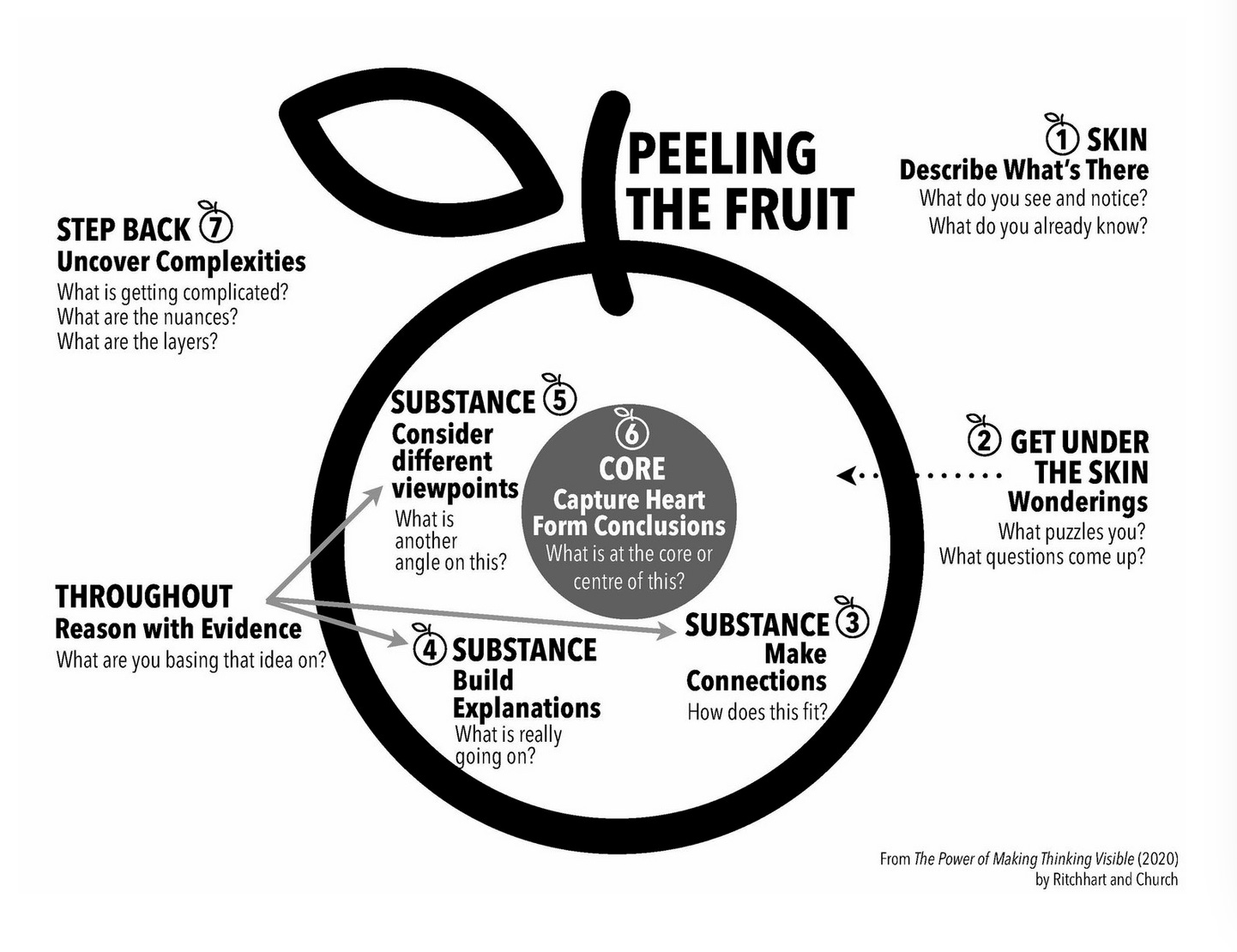
This version of the Understanding Map emphasizes the process of building understanding itself and prompts learners to document its evolution over time, while still incorporating the same fundamental moves. To me, it seems to capture the idea of learning with AI: it is the map, the GPS and the journey of thinking all at once!
Here are some instructions to use it:
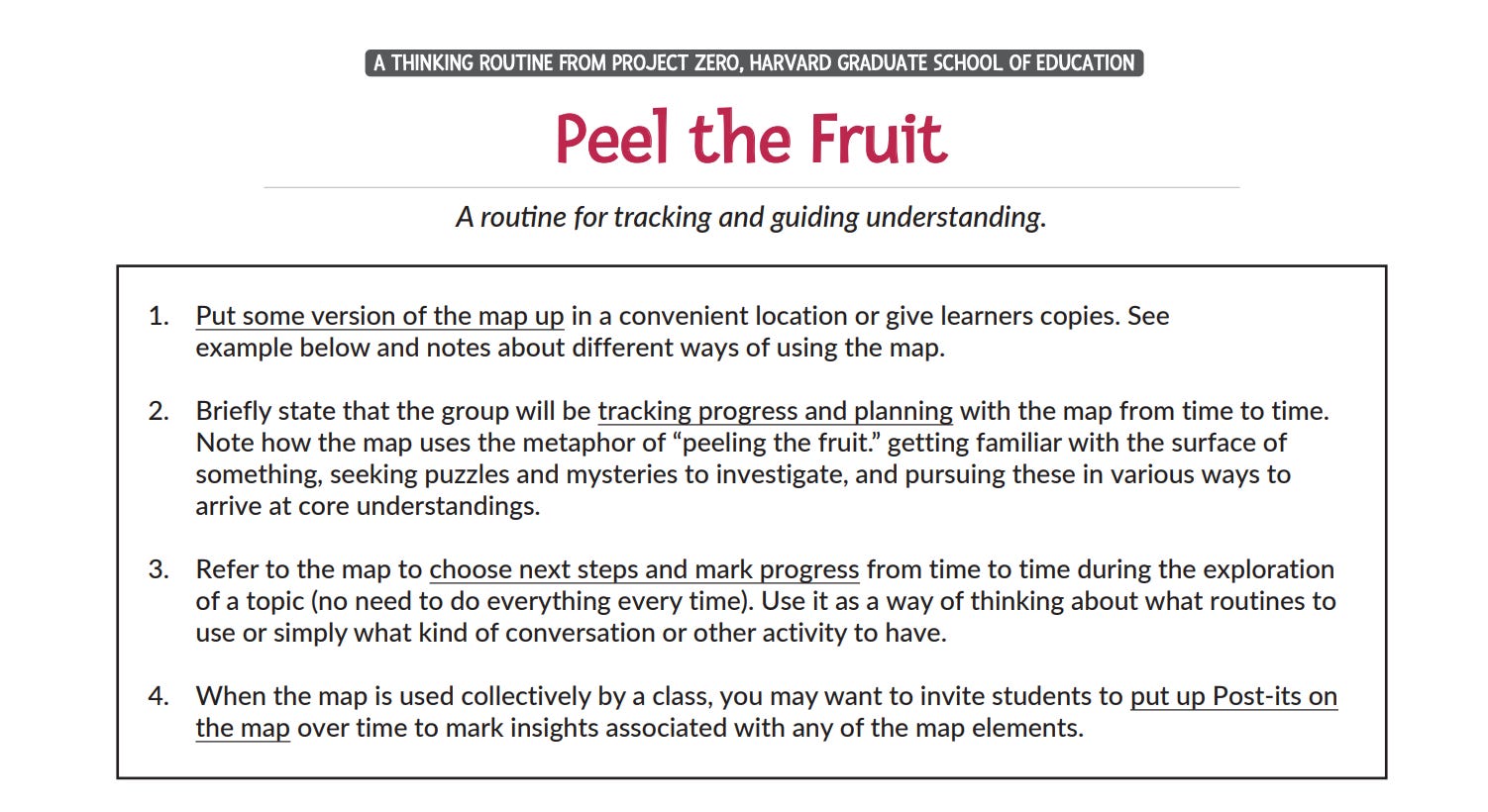
The routine begins at the surface level—what’s observable or known—and prompts students to progressively peel back layers of meaning through questioning, analysis, and reflection, until they reach the “core” of the resource, concept or topic under examination. This scaffolded approach makes it a powerful tool for exploring AI as more than a tool—as a partner in learning. Using this routine, students can go through the process of intentionally making meaning within their interactions with AI while simultaneously documenting it. The evolution of their thinking, not just the end product, becomes visible—and that’s what matters.
Like all Project Zero routines, Peel the Fruit is highly adaptable, and can be used in group discussions or as a solo endeavor. It can happen over a week, an entire unit, or a semester. The documentation can live on classroom walls, in students notebooks, or in digital portfolios.
In all cases, it can guide students to slow down, document and reflect on three important components of learning with AI:
the output of AI (the map)
the prompting of AI (the GPS)
the discussion with AI (the journey)
I do not currently teach a class but would love to see how this is playing out in the classroom, so do not hesitate to reach out if you use these two frameworks to evaluate, use, document and/or reflect on AI tools for learning in your own setting.
At the heart of this work is a simple idea: we want students to thrive in a digital world that includes AI. That means using technology mindfully, understanding its potential and limits, and developing a strong sense of agency around these tools. The future of learning isn’t about robots thinking for us—it’s about us thinking with the help of new tools. And that future begins now, with intentional educators, thoughtful students, and a shared commitment to understanding.